Tree Removal vs. Trimming: Which Does Your Tree Actually Need?
Not every problem tree needs to come down. Learn when trimming saves a tree and when removal is the safer choice for your Duluth property.
“This tree is a problem. Does it need to come down, or can you just trim it?” I hear this question several times a week. The honest answer is: it depends. Here’s how to think through removal versus trimming for your situation.
When Trimming Is the Right Choice
Trimming (or pruning—we use the terms interchangeably) is appropriate when the tree is fundamentally healthy but causing specific problems that can be addressed by removing select branches.
Adhering to Industry Standards
Our team strictly follows ANSI A300 pruning standards because they are the only safe way to touch a tree. These guidelines ensure we never remove more than 25% of a tree’s live foliage in a single season. Removing more sends the tree into shock and stimulates rapid, weak regrowth called “water sprouts.”
Dead Branch Removal
Every mature tree has some deadwood. We call large, detached limbs “widowmakers” for a reason—they pose a silent, serious threat to anyone walking underneath. Removing these branches extends the tree’s safe lifespan without the heavy expense of full removal.
Clearance Pruning
Are branches scraping your roof or blocking a stop sign? Most municipal codes require 8 feet of clearance over sidewalks and 14 feet over streets. Clearance pruning solves these legal and physical headaches while keeping the tree intact.
Crown Thinning and “Lion Tailing”
A dense crown catches wind like a sail. We selectively remove interior branches to let wind pass through, which significantly reduces stress on the trunk during storms. Pro Tip: Watch out for “lion tailing,” a bad practice where an amateur strips all the inner branches and leaves only a tuft at the end. This actually makes branches more likely to snap in high winds.
Hazard Reduction
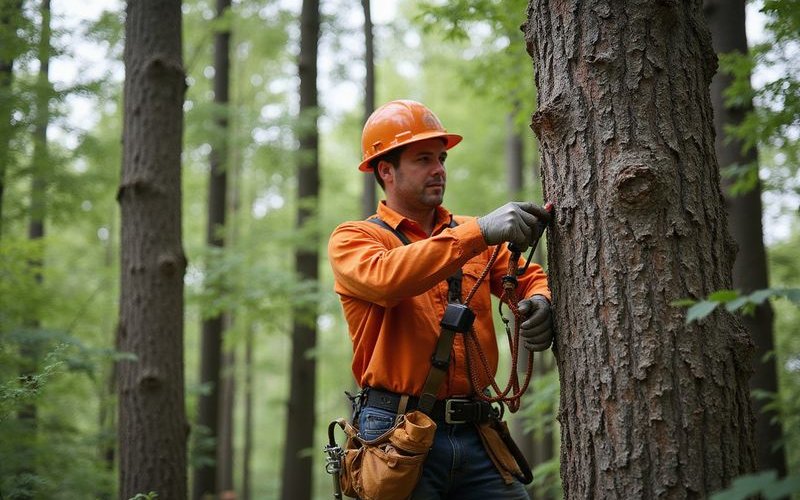
Sometimes a tree has one dangerous feature, like a heavy limb over a deck or a weak branch union. We often use cabling and bracing hardware to support these weak points. This targeted intervention eliminates the specific hazard without needing to cut down the entire tree.
When Removal Is the Better Choice
Tree removal makes sense when the tree can’t be made safe through pruning, when the problems are systemic rather than localized, or when the tree simply needs to go.
Structural Failure: The “Included Bark” Warning
If you see two main trunks growing together in a “V” shape with bark trapped between them, you are looking at “included bark.” This is a weak union that is prone to splitting. Once a main trunk cracks or the root plate starts heaving (lifting the soil), no amount of pruning can restore the tree’s stability.
Severe Decay and Fungi
Internal decay compromises the tree’s structural integrity. If you see Ganoderma (large shelf-like mushrooms) at the base or Laetiporus (bright orange “chicken of the woods”) on the trunk, the tree is likely rotting from the inside out. By the time these fruiting bodies appear, the fungus has often consumed significant structural wood.
Irreversible Decline
Some trees are dying slowly. If more than 30-50% of the canopy is dead or dying, the tree has likely lost the energy reserves needed to recover. Investing in pruning at this stage is usually throwing good money after bad.
Wrong Location
A tree that’s too close to the house, blocking solar panels, or interfering with construction isn’t a candidate for trimming. Foundation repairs from root damage can cost $5,000 to $10,000, which dwarfs the cost of removing the problematic tree.
Problematic Species: The Bradford Pear Example
Some trees are poorly suited for residential settings. The Bradford Pear (Callery Pear) is now banned in states like Ohio and South Carolina due to its invasive nature and tendency to split apart in storms. We almost always recommend removing these specific nuisance species to replace them with stronger natives like Oaks or Maples.
The Decision Framework
Here’s how I think through the removal vs. trimming question:
Trimming vs. Removal: The 2025 Cost & Value Breakdown
| Feature | Tree Trimming | Tree Removal |
|---|---|---|
| Average Cost (US) | $250 - $800 | $400 - $2,000+ |
| Primary Goal | Health, Safety, Aesthetics | Elimination of Risk, Land Clearing |
| Frequency | Every 3-5 Years | One-time Event |
| Risk Level | Low (if done by pros) | High (requires heavy machinery) |
| Best For | Deadwood, Clearance, Structure | Disease, Structural Failure, Bad Location |
Can Trimming Solve the Problem?
If the issue is specific branches—deadwood, clearance, one weak limb—trimming probably works. If the issue is the tree’s overall condition, location, or species, trimming won’t help.
What’s the Tree’s Life Expectancy?
Is this a mature tree with decades of life left, or one in terminal decline? Investing in pruning makes sense for trees with long futures. For declining trees, removal now usually costs less than repeated pruning followed by eventual removal.
What’s the Risk If We’re Wrong?
A tree over a rarely-used back corner has low consequences if it fails. A tree over your bedroom has high consequences. Higher-risk situations favor more aggressive intervention, including removal.
What’s the Cost Comparison?
Sometimes heavy pruning to make a marginal tree safe costs nearly as much as removing it. 2025 data shows that complex pruning on a large tree can run over $1,000, while removal might be $1,200. We encourage you to look at the long-term economics rather than just the immediate invoice.
Real-World Examples
Example 1: The Leaning Birch
Situation: 40-foot paper birch leaning 15 degrees toward the house. No visible root heaving. The tree has leaned this direction for at least 10 years.
Decision: Monitor, don’t remove yet. Trees can lean and remain stable if the lean developed slowly during growth. The birch isn’t showing signs of active failure. We recommended annual inspection and storm-season awareness.
Example 2: The Oak with Deadwood
Situation: 70-foot red oak with significant deadwood in the upper crown. Some branches are 4-6 inches diameter. Tree is over a deck used daily in summer.
Decision: Heavy pruning now. The tree’s trunk and lower structure are sound. Removing the deadwood eliminates the immediate hazard. The oak has decades of healthy life ahead if we address the deadwood.
Example 3: The Split Maple
Situation: 50-foot maple with co-dominant stems showing included bark. Crack visible where the trunks meet. Recent lean on one side.
Decision: Removal. The crack indicates active failure in progress. Cabling might slow it, but the tree is structurally compromised. Removal now, on our terms, is safer than waiting for it to split during a storm.
Example 4: The Too-Close Pine
Situation: 60-foot white pine 8 feet from the foundation. Healthy tree, but roots are lifting the sidewalk and branches constantly drop debris on the roof.
Decision: Removal. The tree isn’t hazardous in the structural sense, but its location creates ongoing problems. Repeated trimming won’t solve the root issue. Better to remove it and plant something appropriate for the space.
Getting an Honest Assessment
Some tree companies push removal because it’s more profitable than trimming. Others default to trimming to generate repeat business. An ISA Certified Arborist should give you an objective assessment based on the tree’s actual condition and your specific situation.
When we evaluate your tree, we consider:
- Structural integrity (trunk, branches, roots)
- Health and vigor (foliage, growth rate, disease signs)
- Location and targets (what could the tree damage?)
- Your goals (preserve the tree? solve a specific problem?)
We’ll tell you honestly whether trimming can address your concerns or whether removal is the better choice. Sometimes the answer is “either would work, here’s the trade-off.”
Not sure about a tree on your property? Call (218) 555-0391 for an assessment. We’ll give you a straight answer about what your tree actually needs.
Erik Janssen
ISA Certified Arborist serving Duluth and the North Shore since 2016. Dedicated to professional tree care and honest advice.