7 Signs Your Tree Needs to Be Removed (Don't Ignore #4)
Learn the warning signs that a tree on your property is dangerous and needs removal. ISA Certified Arborist explains what to look for.
7 Signs Your Tree Needs to Be Removed (Don’t Wait Until It Falls)
As an ISA Certified Arborist, I’ve noticed a dangerous trend: most homeowners wait until a storm hits to worry about their trees. You know how it goes—everything looks fine until the wind picks up, and suddenly you’re wondering if that big oak is going to land on the roof. From what we’ve seen in the field, trees rarely fail without giving a warning first.
The difference between a safe property and a disaster often comes down to spotting these subtle signals early. We want to help you read those signs before the weather makes the decision for you. Here is exactly what our team looks for when assessing whether a tree is past the point of return.
1. Dead or Dying Branches in the Crown
A few dead twigs are normal, but widespread dieback is a red flag. When you see large sections of the canopy turning brown or bare while the rest of the tree is green, the tree is shutting down systems to survive. We call this “crown dieback,” and once it exceeds 25% to 30% of the canopy, the tree is often in irreversible decline.
Specific indicators of danger:
- “Widow Makers”: This industry term refers to large, detached branches that are hung up in the canopy, waiting for a breeze to dislodge them.
- Missing Bark on Upper Limbs: If you see smooth wood where rough bark should be, that branch has likely been dead for months.
- Premature Color Change: Leaves turning brown or yellow in mid-summer often signal severe stress or root issues.
- Retrenchment: Old trees sometimes shed their outer branches to conserve energy for the trunk, a sign they are nearing the end of their life cycle.
Pruning can sometimes solve the problem if the deadwood is limited. If the dieback is systemic, however, professional tree removal is usually the safer choice to prevent injury from falling debris.
2. Trunk Damage and Decay
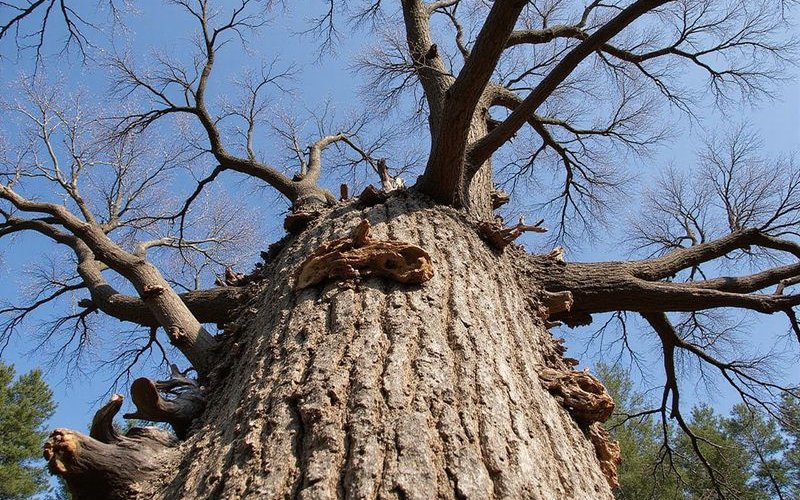
The trunk supports the entire weight of the tree, so any compromise here is critical. We always check for structural defects that might not look scary to a layperson but indicate a hollow or weak core. A common rule of thumb among arborists is the “t/R ratio”—if the shell of healthy wood is less than 30% of the trunk’s radius, the risk of failure skyrockets.
Critical defects to inspect:
- Deep Cracks: Vertical splits that go into the wood (not just the bark) suggest the tree is physically tearing itself apart under its own weight.
- Cavities and Hollows: While some hollows are stable, a large opening where you can see rotting wood inside often means the structural cylinder is failing.
- Fungal Fruiting Bodies: Mushrooms like Ganoderma applanatum (Artist’s Conk) or Laetiporus (Chicken of the Woods) growing on the trunk are not just surface issues; they indicate active rotting of the heartwood inside.
- Cankers: These sunken, dead patches of bark can girdle the trunk, cutting off the flow of nutrients like a tourniquet.
If you see these signs, the tree’s internal strength is likely far worse than its external appearance suggests.
3. Root Problems
Roots are the most difficult part of the tree to assess because you can’t see them. Failures here are often catastrophic because the entire tree falls over, root plate and all. We pay close attention to the Critical Root Zone (CRZ), generally defined as the area within the drip line or a radius of 1-1.5 feet for every inch of trunk diameter.
Warning signs of root failure:
- Soil Heaving: If the ground around the base of the tree lifts or cracks during a windy day, the roots are actively pulling out of the soil.
- Fungal Growth at the Base: Armillaria (Honey Fungus) appearing near the roots often means the anchor roots are rotting away.
- Recent Construction: Trenching or paving within the CRZ cuts the stabilizing roots; symptoms of this damage often take 3-5 years to fully appear.
- Girdling Roots: Roots that wrap around the trunk act like a chokehold, compressing the vascular system and slowly killing the tree.
Damage to more than 30-40% of the root system typically renders a tree unstable.
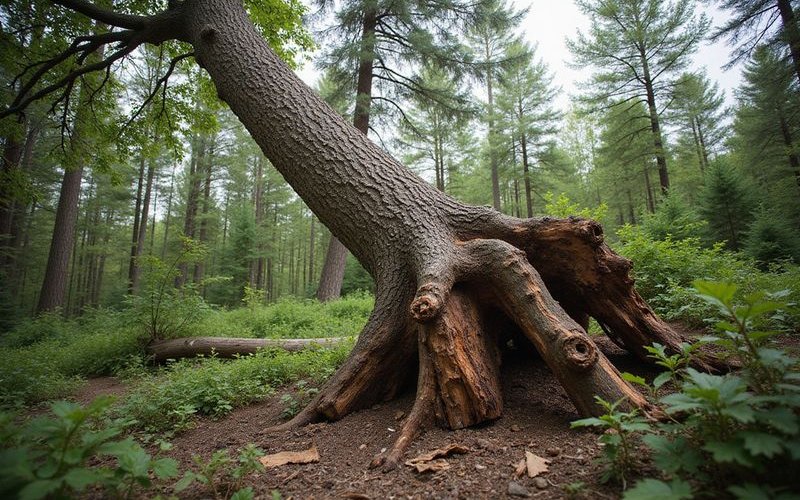
4. Significant Lean (Especially New Lean)
Trees often grow at an angle to reach sunlight, which is natural and usually stable. A lean that has developed recently or changed angle is an emergency. This shift indicates the root plate is losing its grip on the soil.
Distinguishing safe vs. dangerous leans:
- The 15-Degree Rule: Many experts consider a lean exceeding 15 degrees from vertical to be hazardous, regardless of the cause.
- Soil Mounding: Look for a mound of soil on the side opposite the lean, which indicates the roots are being ripped out of the ground.
- Fresh Soil Cracks: New cracks in the dirt around the base mean the tree moved recently.
- Corrected Growth: A tree that grew crooked but then straightened its top (a “sweep”) is usually correcting itself; a tree that leans straight from the ground up is often failing.
Recent movement requires immediate professional intervention.
5. Multiple Trunks with Included Bark
Some trees split into two or more main stems, known as co-dominant stems. The danger lies in the shape of the connection. A “U” shape is generally strong, but a “V” shape is often weak.
Why “included bark” is dangerous:
- Bark Trapped Inside: In a tight V-union, bark gets trapped between the two growing stems.
- Lack of Connection: Because bark does not stick to bark, there is no physical wood connection holding the stems together at that point.
- The “Wishbone” Effect: Wind pushes the stems apart, and like a wishbone, the union splits down the middle.
- Assessment: If you see a seam or crack running down the union of two large trunks, the tree is at high risk of splitting during a storm.
Cabling can sometimes secure these stems, but if the decay is deep, removal is the only way to ensure safety.
6. Storm Damage That Compromised Structure
Severe weather can leave a tree standing but structurally ruined. We often see trees that survived a hurricane or blizzard only to collapse during a minor thunderstorm months later. Hidden injuries from torsion (twisting) or compression can weaken the wood fibers permanently.
Post-storm red flags:
- Torsion Cracks: Spiraling cracks down the trunk indicate the tree was twisted violently, separating the wood layers.
- “Hangers”: Broken branches that are still attached or caught in the canopy pose an immediate threat to people below.
- Root Shock: Even if the tree didn’t fall, extreme swaying can snap small feeder roots or loosen the main anchor roots.
- Leader Loss: If the main leader (the top vertical stem) snapped off, the tree may develop weak, unstable new growth at the break point.
Any tree that has lost a significant portion of its crown or shows trunk twisting needs a detailed risk assessment.
7. The Tree Is Just in the Wrong Place
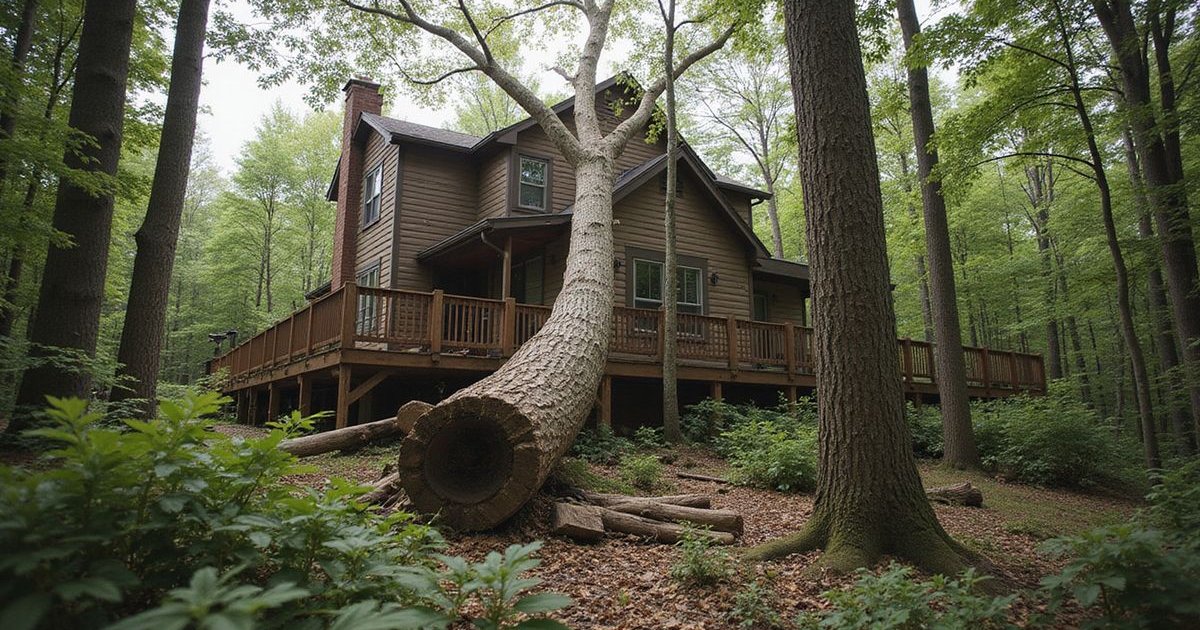
A tree can be perfectly healthy and still need removal if it threatens your home or infrastructure. Planning mistakes made 20 years ago often result in massive oaks growing five feet from a foundation.
Common proximity issues:
- Foundation Clearance: Large species like oaks or maples should ideally be planted 20-50 feet away from a home; smaller trees need 8-10 feet.
- Roof and Siding Damage: Branches rubbing against the house can strip shingles and provide a bridge for pests like carpenter ants or squirrels.
- Solar Obstruction: A tree shading expensive solar panels negates your investment.
- Utility Conflicts: Trees growing into high-voltage lines require constant, ugly topping by utility companies; removal and replacement with a smaller species is often better.
Removing a tree that is too close to a structure prevents expensive repairs to your foundation, roof, or driveway later.
What About Saving the Tree? Cost vs. Value
Deciding between preservation and removal often comes down to the numbers. We always prefer to save a tree when possible, but safety and budget are real constraints.
The following table compares the typical costs you might face in 2026.
| Factor | Tree Preservation / Maintenance | Tree Removal |
|---|---|---|
| Estimated Cost | $250 - $800 (Pruning/Cabling) | $385 - $2,000+ (Depends on size) |
| Outcome | Extends life, improves safety | Eliminates all risk immediately |
| Maintenance | Ongoing (every 2-4 years) | None (stump grinding is one-time) |
| Best For | High-value, sentimental, or historic trees | Hazardous, diseased, or invasive trees |
Factors favoring preservation:
- The tree adds significant property value or shade.
- The defect is manageable (e.g., a single dead branch).
- You are willing to pay for ongoing inspections.
Factors favoring removal:
- The tree has a target (house, playground, car).
- The species is invasive or weak-wooded (like Bradford Pear or Silver Maple).
- Treatment costs exceed the cost of removal and replanting.
Get a Professional Assessment
You don’t have to make this call alone. We have seen too many people try to diagnose a tree from the ground, only to miss the internal decay that caused a failure later. A professional assessment provides a clear, objective look at the risks.
Our team will evaluate the soil, root plate, trunk integrity, and canopy health to give you a definitive answer.
Concerned about a tree on your Duluth property? Call (218) 555-0391 for an assessment. We’ll tell you honestly whether the tree needs to go or can be saved.
Erik Janssen
ISA Certified Arborist serving Duluth and the North Shore since 2016. Dedicated to professional tree care and honest advice.