Emerald Ash Borer: Should You Treat or Remove Your Ash Tree?
When is an ash tree worth treating for EAB, and when is removal the better choice? An ISA Certified Arborist breaks down the decision.
This guide helps you decide whether to treat or remove an ash tree infested with Emerald Ash Borer, using the latest 2026 data.
Emerald Ash Borer: Should You Treat or Remove Your Ash Tree?
You’ve learned that emerald ash borer (EAB) has reached the Duluth area. You have ash trees. Now you face a decision: treat and protect your trees, or remove and replace them. Neither answer is universally right—it depends on your specific situation.
Here’s how to think through the treat-or-remove decision.
The Treatment Option
How EAB Treatment Works
Systemic insecticides are absorbed by the tree and kill EAB larvae as they feed. We find the most effective option is trunk injection, where insecticide is injected directly into the tree’s vascular system.
Trunk-injected treatments:
- Specific Chemistry: We rely on Emamectin Benzoate (often branded as TREE-age), which is the industry gold standard. It offers superior protection compared to older imidacloprid soil drenches.
- Duration: Provides 2 full years of protection (sometimes 3 in low-pressure areas).
- Efficacy: Delivers 99% larval kill rates when applied correctly.
- Professional Requirement: Requires licensed application due to the specialized equipment and restricted-use chemicals.
Insider Tip: Watch for the Black Locust trees to bloom. In our region, this natural event perfectly coincides with the ideal window for EAB treatment (roughly mid-May to June), signaling that the tree’s vascular system is actively transporting water and nutrients.
Treatment Costs
For professional trunk injection using emamectin benzoate:
- Small ash (under 15” diameter): $100-$165 per treatment
- Medium ash (15-24” diameter): $165-$275 per treatment
- Large ash (over 24” diameter): $275-$450+ per treatment
This is a recurring cost every 2 years. We often explain it to clients as “rent” for keeping the tree—typically costing less than a monthly streaming subscription when broken down over 24 months.
Treatment Success Factors
Treatment works best when:
- The tree retains at least 70% of its canopy.
- Treatment starts before infestation is visible (preventative is always cheaper).
- Applications occur in late spring/early summer when the tree is transpiring heavily.
- You commit to the long-term schedule.
Treatment may fail or be impractical when:
- Canopy Dieback exceeds 30%: At this stage, the vascular system is often too damaged to uptake the chemical.
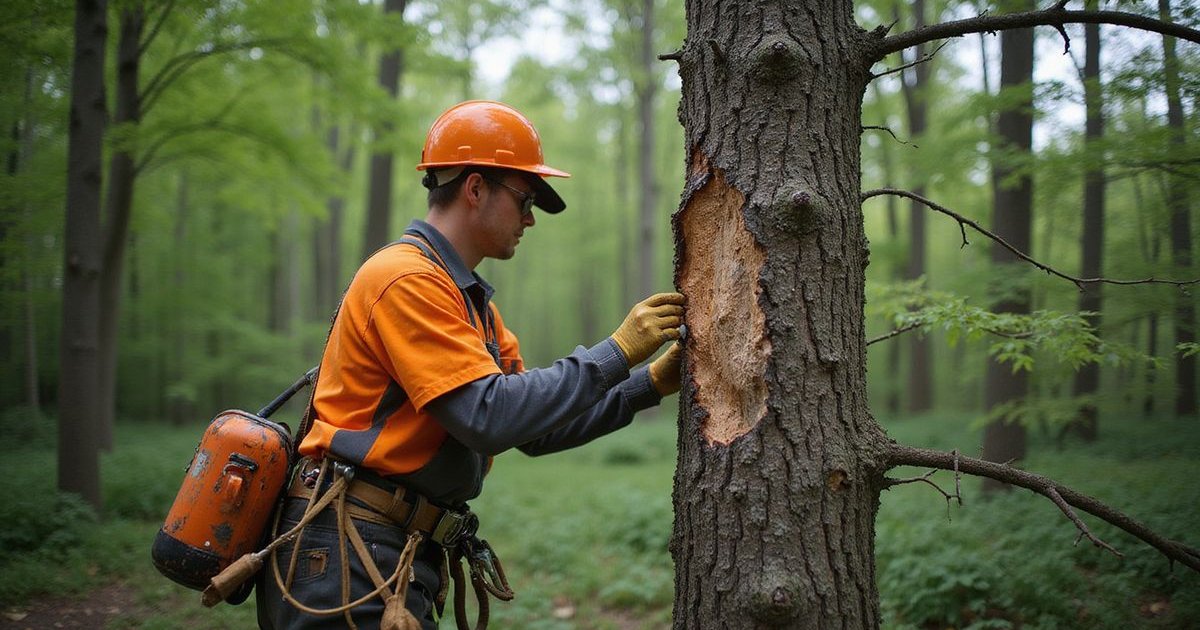
- Woodpecker Damage is Heavy: This “blonding” or “flecking” of the bark usually signals a high larval population.
- Root Damage Exists: Construction or compaction near the roots limits the tree’s ability to absorb the medicine.
- Access is Poor: If we cannot reach the trunk flare easily, effective injection becomes difficult.
The Removal Option
Why Remove Instead of Treat?
Sometimes removal makes more sense than saving the tree:
The tree is already failing. Once canopy loss exceeds 30-40%, treatment success drops significantly. You’d be investing in a tree that’s unlikely to recover.
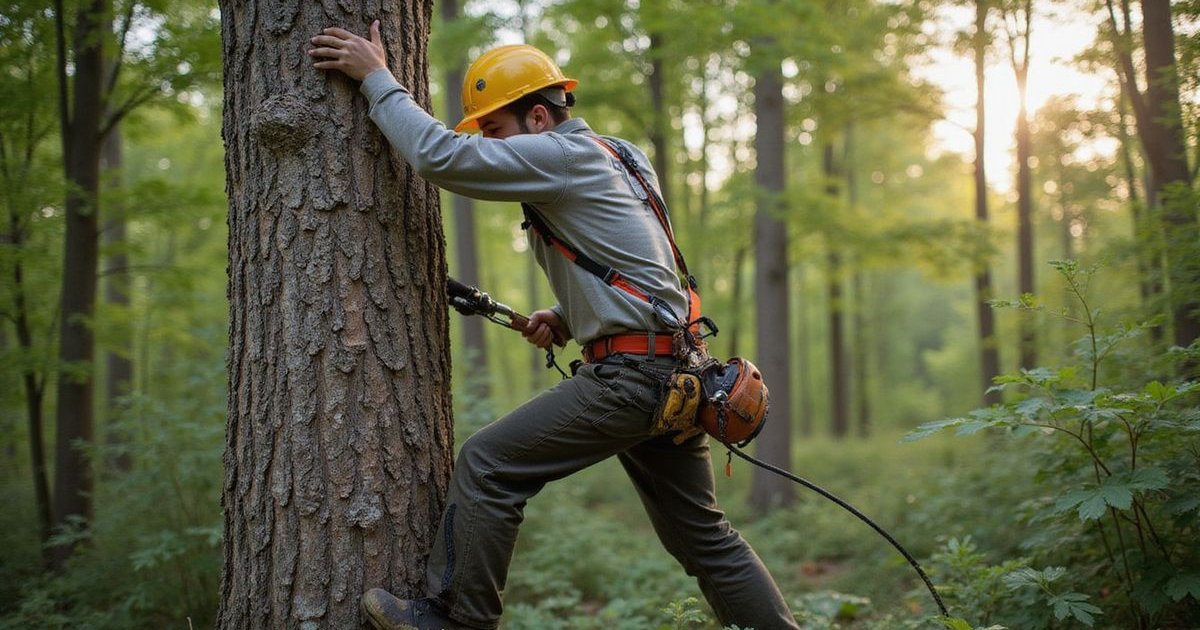
The hazard of “Brittle Ash”. Ash wood loses moisture incredibly fast once the tree dies, becoming dangerous to climb or fell. We call this the “brittle ash” phenomenon—branches can snap without warning, and trunks can split vertically (known as “barber chairing”) during cutting.
Multiple trees are involved. If you have five ash trees and treating all of them isn’t feasible, strategic removal may be the better approach.
The tree is in a poor location. An ash tree that’s too close to the house, blocking views, or in the way of future plans might be better removed regardless of EAB.
Budget constraints. Treatment is an ongoing expense. Removal is a one-time cost. Sometimes finances make the decision.
Removal Costs
Ash tree removal prices in the US have risen due to the increased danger of working with dead ash.
Typical 2026 Removal Estimates:
- Small ash: $650-$900
- Medium ash: $900-$1,800
- Large ash: $1,800-$3,500+ (Complex removals requiring a crane can exceed $5,000)
Additional Costs:
- Stump grinding: $150-$400 additional
- Replacement planting: $300-$600 for a quality 1.5-inch caliper nursery tree
Insider Warning: Do not wait until the tree is completely dead. Many tree companies (ours included) are forced to use cranes for dead ash removal because it is unsafe to climb them. This “crane fee” can instantly double your removal cost compared to taking down a live, stable tree.
The Decision Framework
Factors Favoring Treatment
✓ Tree is high-value: Large, mature shade tree in a prominent location ✓ Tree is healthy: Good structure, full canopy, no other major issues ✓ Early intervention: No EAB signs yet or very early infestation ✓ Budget allows: Can commit to ongoing treatment indefinitely ✓ Tree is irreplaceable: Would take 30+ years for a replacement to match
Factors Favoring Removal
✓ Tree is already infested: More than 20-30% canopy loss ✓ Tree has other problems: Disease, structural defects, storm damage ✓ Tree is poorly located: Too close to structures, blocking views, in the way ✓ Multiple trees: Can’t afford to treat all, better to remove selectively ✓ Budget is limited: One-time removal cost vs. ongoing treatment
The Break-Even Analysis
Consider the long-term economics of a 20-inch ash tree:
| Feature | Treatment Strategy (20 Years) | Removal Strategy |
|---|---|---|
| Immediate Cost | $220 (First injection) | $1,500 (Removal & Stump) |
| Recurring Cost | $220 every 2 years | $0 |
| Total 20-Year Cost | ~$2,200 | ~$2,000 (Includes $500 replanting) |
| Tree Value | Large, mature shade | Sapling growing to small tree |
| Property Benefit | ~$168/year in energy savings/value | Negative initial value |
The Bottom Line: For a tree you want to keep, treatment often costs less over a 15-year period than removal and replacement. The “break-even” point is often nearly two decades out.
Specific Scenarios
Scenario 1: Beautiful Shade Tree, No EAB Yet
Situation: 30-inch diameter ash in your front yard, providing major shade, no signs of infestation.
Recommendation: Treat. This tree provides approximately $3,300 in accumulated benefits over the next 20 years. Removing it would cost $3,000+, while protecting it costs roughly $350 every two years.
Scenario 2: Already Infested, 40% Canopy Loss
Situation: 20-inch ash showing significant dieback, many D-shaped exit holes, epicormic sprouting.
Recommendation: Remove. Treatment at this stage has low success probability. The tree is declining rapidly and will likely die regardless. Better to remove now while it’s still structurally sound.
Scenario 3: Three Ash Trees, Limited Budget
Situation: Three medium ash trees on your property. Treating all three isn’t affordable.
Recommendation: Prioritize. Treat the most valuable tree (best location, best health) and plan for removal of the others. Better one healthy, protected tree than three struggling ones.
Scenario 4: Ash Tree Near the House, Average Condition
Situation: 18-inch ash 25 feet from your house. Average health, no EAB yet, but you’ve been thinking about removal anyway.
Recommendation: Remove. If you were already considering removal, EAB tips the scale. Take it down before infestation adds urgency and before the wood becomes hazardous.
Scenario 5: Forest Setting, Many Ash
Situation: Your wooded lot has dozens of ash trees of various sizes, mixed with other species.
Recommendation: Selective approach. You can’t treat dozens of forest trees. Identify a few high-value specimens for treatment (near the house, along the driveway, main view trees). Let the rest follow their natural course. Plan for hazard tree removal as they decline.
Questions to Ask Yourself
-
How much do I value this specific tree? Would losing it significantly impact my property?
-
What’s the tree’s current health? Beyond EAB, is it a good tree worth saving?
-
What’s my budget? Can I commit to treatment every 2-3 years indefinitely?
-
What’s my timeline? Am I staying in this house long enough to benefit from treatment?
-
Do I have other options? If this tree fails, could a replacement serve my needs?
Getting Professional Input
This decision benefits from expert assessment. An ISA Certified Arborist can:
- Evaluate your specific tree’s health and structure
- Assess EAB infestation level (if any)
- Discuss treatment feasibility and timing
- Provide removal estimate for comparison
- Recommend replacement species if removal makes sense
Need help deciding about your ash trees? Our emerald ash borer solutions include assessment and treatment options. Call (218) 555-0391 for honest recommendations based on your trees’ actual condition.
Erik Janssen
ISA Certified Arborist serving Duluth and the North Shore since 2016. Dedicated to professional tree care and honest advice.