Birch Tree Decline in Duluth: Is It Drought or Disease?
Duluth's birch trees are struggling. Learn to distinguish drought stress from bronze birch borer and what treatment options exist.
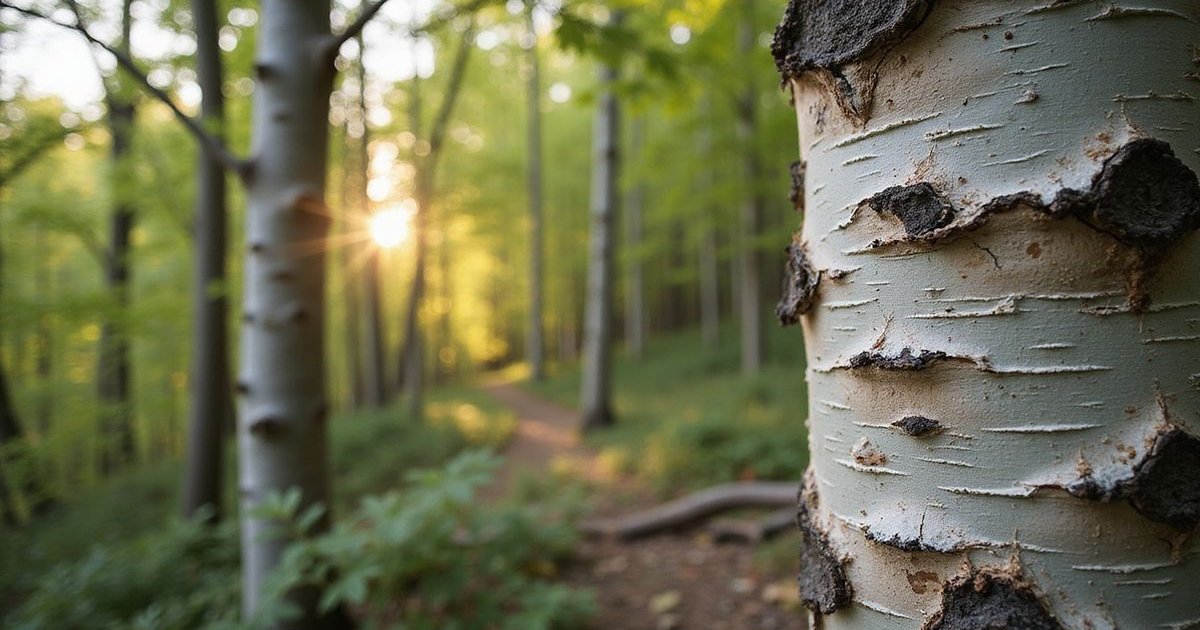
Some of the most heartbreaking calls we receive at our office start the same way. A homeowner tells us their paper birch—the one that’s been in the front yard for thirty years—suddenly looks like it’s dying from the top down. You might think it’s just a bad year, but the data tells a different story.
Duluth’s birch population is currently fighting a “stress complex” caused by the compounding effects of the 2021-2023 droughts and our rapidly warming winters. From what we are seeing in the field, this isn’t just about lack of water; it is a battle between our changing climate and the trees’ natural defenses.
Let’s look at the data, what it’s actually telling us, and then explore a few practical ways to respond.
The Birch Decline Problem
Birch decline isn’t a single disease—it’s a combination of stressors that overwhelm trees already at the edge of their comfort zone. Our arborists typically trace the issue back to four specific pressures:
Climate stress: Birch trees are built for cold, consistent winters. Data from the University of Minnesota shows our average winter temperatures have risen by 5.4°F, which disrupts the dormancy cycles these trees rely on.
Pest pressure: The Bronze Birch Borer (BBB) is the primary enemy here. Healthy birch trees can actually drown these borers with sap, but dehydrated trees lose this natural defense system.
Site conditions: Urban soil in Duluth is often compacted or clay-heavy, unlike the loose, cool forest floor birch roots need. We often find that “urban heat islands” near driveways raise soil temperatures enough to kill fine feeder roots.
Age: Many landscape birch planted in the 1970s and 80s are reaching the end of their 40-50 year urban lifespan.
The result is a cascade: stress weakens trees, weakened trees attract borers, and borers finish the job. Breaking this cycle requires identifying which stage your tree is currently in.
Drought Stress Symptoms
Birch are shallow-rooted, with most feeder roots sitting in the top 12-18 inches of soil. When water is scarce, they show characteristic stress signals that many people mistake for early fall color:
Early leaf yellowing: You will see leaves turn yellow and drop in July or August, weeks before the autumn shift.
Marginal leaf scorch: Look for brown, crispy edges on the leaves, which is a classic sign the roots can’t pump water fast enough to cool the foliage.
Premature defoliation: The tree may drop its inner leaves first to protect the growing tips.
Wilting: Leaves droop noticeably during hot afternoons but might perk up the next morning.
Sparse canopy: You might notice you can see the sky through the tree more easily than in previous years.
Slow recovery: Symptoms improve when rain returns, but the tree often remains thin for the rest of the season.
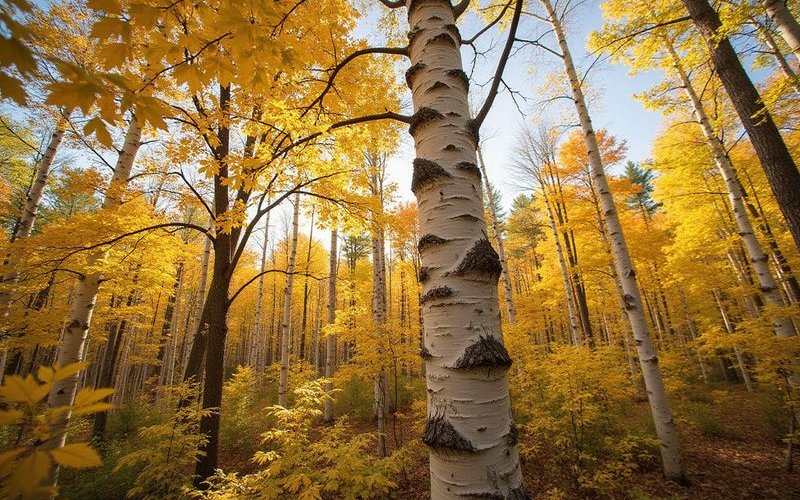
Bronze Birch Borer Symptoms
Bronze birch borer (BBB) is the insect that kills stressed birch, and it moves fast. Adult beetles lay eggs on the bark in early summer, often timing their emergence with the bloom of the Vanhoutte spirea shrub.
Dieback from the top down: This is the hallmark sign. We almost always see the very top branches die first because the larvae cut off nutrient flow to the furthest points.
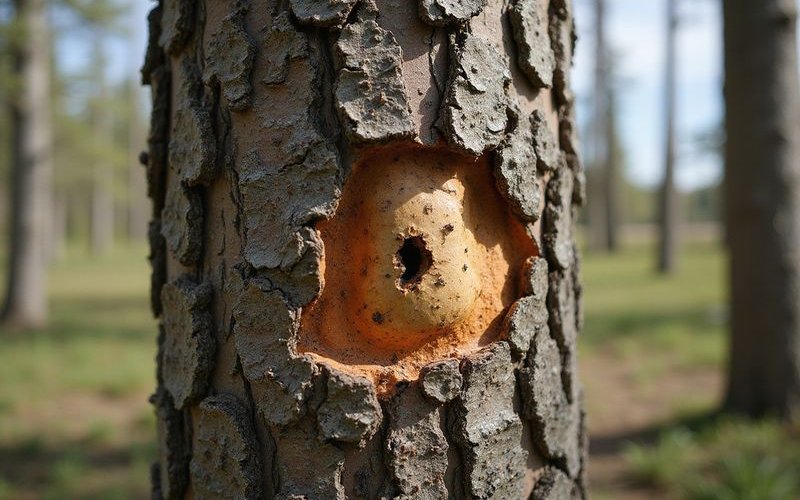
D-shaped exit holes: Adult beetles emerge through distinct holes about the size of a capital “D” (roughly 1/8 inch wide).
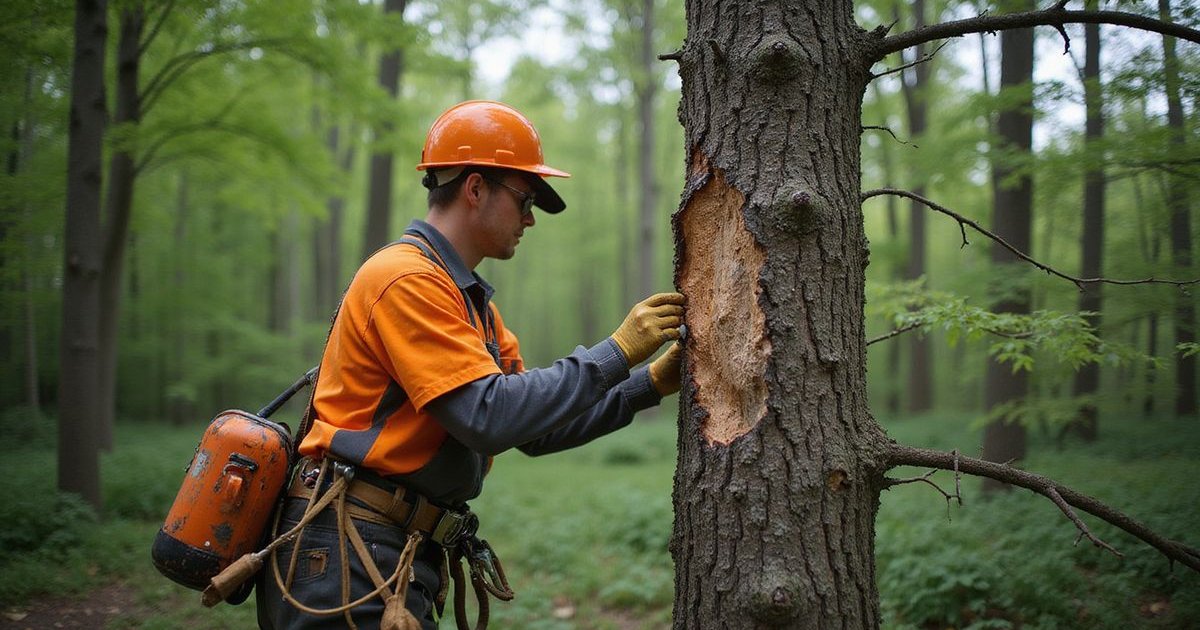
Raised ridges on bark: We call this the “rumpled bark” look. It happens because the tree tries to grow callus tissue over the tunnels the larvae are digging underneath.
Branch flagging: You might see random dead branches with brown leaves hanging on, scattered through the crown.
Epicormic sprouting: The tree may panic and push out clusters of small shoots (suckers) along the main trunk.
Woodpecker activity: If you see woodpeckers working on your birch in summer, they are likely hunting for borer larvae.
How to Tell the Difference
The patterns differ in critical ways. Use this comparison to spot the specific warning signs:
| Symptom | Drought Stress | Bronze Birch Borer |
|---|---|---|
| Canopy dieback pattern | Uniform thinning throughout | Distinct top-down death |
| Bark condition | Normal, maybe dry | ”Rumpled” ridges or bumps |
| Exit holes | None | D-shaped holes (1/8 inch) |
| Leaf drop | Inner leaves drop first | Leaves turn brown and stay attached |
| Recovery potential | Improves with deep watering | Continues declining without chemical help |
| Timing | During/after dry spells | Progressive regardless of recent rain |
The key distinction is the direction of death. Drought makes the whole tree look tired; borers kill it from the top down.
Often, it’s both. A birch that has been drought-stressed for several years is essentially a welcome mat for borers.
Treatment Options
For Drought Stress
If your birch is showing drought symptoms but no borer evidence, immediate cultural changes can save it.
The “Screwdriver Test”: Before you water, push a 6-inch screwdriver into the soil near the trunk. If it’s hard to push in, your soil is too dry or compacted.
Deep watering: Birch need consistent moisture, roughly 1 inch of water per week. We recommend using a soaker hose for 2-3 hours to ensure the water penetrates deep into the root zone rather than running off.
Mulching: Apply a 3-4 inch layer of wood chips over the root zone to simulate a forest floor. Keep the mulch pulled back 6 inches from the trunk to prevent rot.
Reducing competition: Turf grass is a heavy drinker that steals water from trees. Replacing grass with mulch under the canopy can double the available moisture for your birch.
Avoiding fertilization: Do not fertilize a drought-stressed tree. High-nitrogen fertilizer forces leaf growth that the compromised root system cannot support.
For Bronze Birch Borer
If you see top-down dieback and D-shaped exit holes, you need to act immediately.
Systemic insecticides: We typically use professional-grade injections like TREE-age (emamectin benzoate). This product is injected directly into the trunk and provides protection for two years.
Treatment timing: Treatments are most effective in spring before the adults emerge. If you treat in late summer, you are only killing the larvae for next year.
Pruning: You should remove the dead top branches, but only after the treatment has taken effect. Pruning a live, infested tree can release scents that attract even more beetles.
Water and care: Treatment kills the bugs, but water heals the tree. You must combine chemical treatment with the watering steps above.
When Treatment Isn’t Worth It
We always try to save trees, but sometimes the math doesn’t work.
- The 50% Rule: If more than 50% of the canopy is dead, the tree’s vascular system is likely too damaged to transport the insecticide.
- Cost Comparison: A two-year treatment cycle might cost $200-$300, whereas removing a mature birch near a house can easily cost $1,500 or more.
- Location: If the tree is planted in a “hot spot” (surrounded by concrete on the south side), it will fight a losing battle forever.
Sometimes the kindest choice is removal and replacement with a species better suited to the site.
Prevention for Healthy Birch
If your birch trees are still healthy, your goal is to make them invisible to pests.
Site selection: Birch perform best on the north and east sides of buildings. This placement protects them from the scorching afternoon sun that stresses them out.
Mulch generously: A wide mulch ring is the single best thing you can do for a birch tree. It keeps roots cool and prevents mower damage to the trunk.
Water during drought: Don’t assume a light rain is enough. Our rule of thumb is to water if we haven’t had a soaking rain in 7-10 days.
Minimize stress: Avoid digging or construction near the root zone. Birch roots are incredibly sensitive to disturbance.
Consider preventive treatment: If you have a high-value specimen, preventive injections are cheaper and more effective than trying to cure an infestation later.
Choosing the Right Birch
If you are planting new birch or considering what to do after removing a declining tree, species selection is critical.
River Birch (Betula nigra)
This is our top recommendation for the Duluth area. River birch is highly resistant to the Bronze Birch Borer and handles heat much better than paper birch.
- Top Cultivar: Look for ‘Heritage’ or ‘Fox Valley’.
- Feature: The bark exfoliates in cinnamon and salmon colors rather than pure white.
Paper Birch (Betula papyrifera)
This is the native icon, but it struggles in city conditions.
- Best Use: Plant these only in cool, shaded areas with good soil.
- Clump Form: Multi-stem clumps provide some insurance; if one stem fails, the others may survive.
Whitespire Birch (Betula populifolia ‘Whitespire’)
This is a popular alternative that offers white bark with better borer resistance than the native paper birch.
- Note: Make sure it is true ‘Whitespire’ stock, as generic gray birches are less resistant.
Yellow Birch (Betula alleghaniensis): Native to our region, more tolerant of site variation than paper birch.
Paper birch will always be challenging in urban landscapes. For many sites, a related species provides similar appeal with significantly better survival odds.
The Bigger Picture
Birch decline in Duluth reflects broader climate changes. Our summers are trending warmer, and our rainfall is becoming more erratic. Trees at the southern edge of their range—like paper birch—are increasingly stressed by these shifts.
This doesn’t mean birch will disappear from our landscape, but it does mean they need more help than they once did. If you have birch you want to keep, proactive care is no longer optional.
Get Your Birch Assessed
Not sure if your birch is drought-stressed, borer-infested, or both? Our tree risk assessment service can answer the question and guide your investment.
Call (218) 555-0391 to schedule a birch tree evaluation. We’ll examine your trees, identify the specific stressors involved, and help you decide if treatment or replacement is the smarter financial move.
Erik Janssen
ISA Certified Arborist serving Duluth and the North Shore since 2016. Dedicated to professional tree care and honest advice.